
ENTRANCEBanshoreki
Free astrology tools that show their work. Every position comes from NASA JPL Horizons tables and Astronomy Engine, and the differences are published, not just claimed. Accurate enough for professional astrologers. Nothing you type leaves your device.
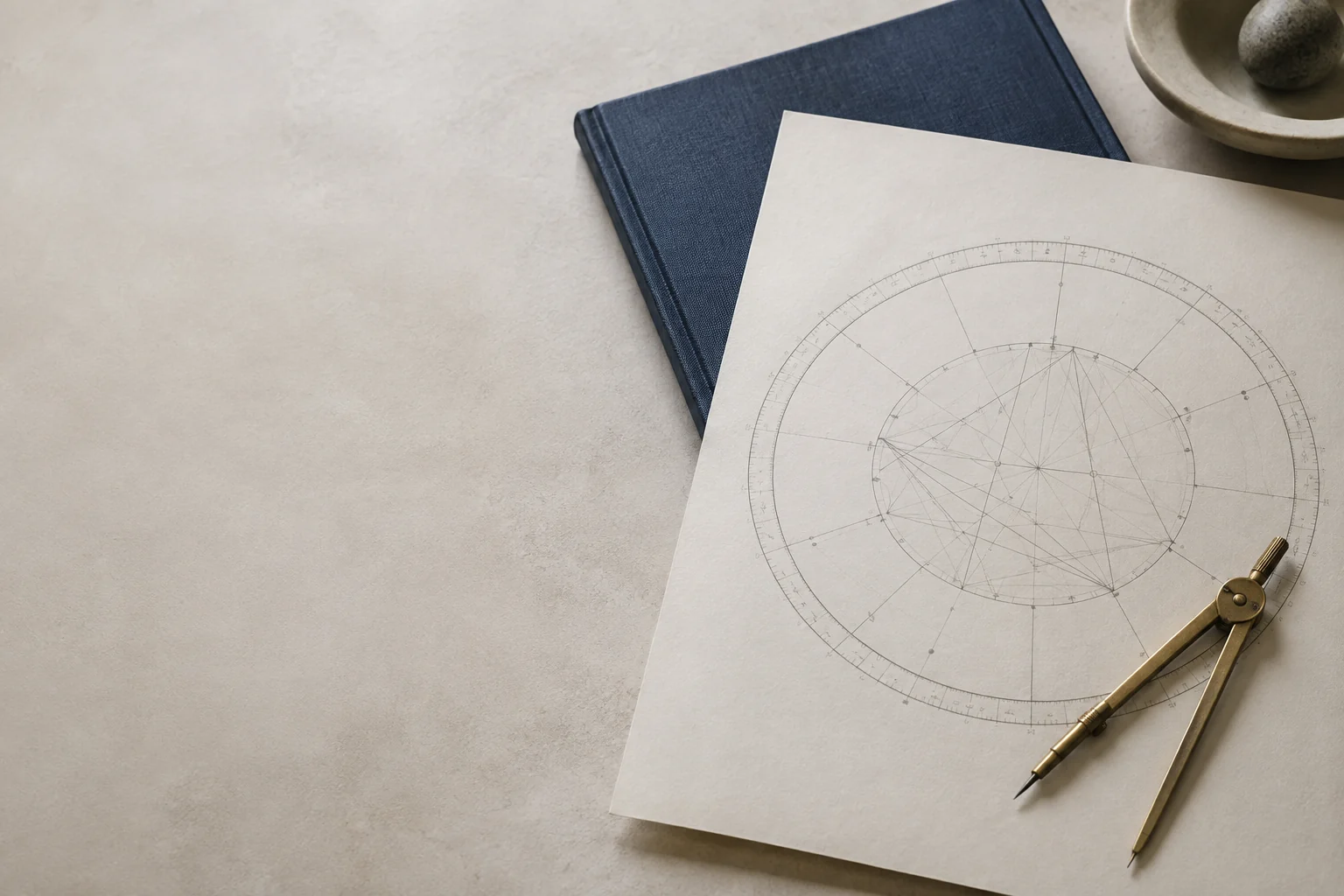
Start from a person: a one-page consultation desk, chart wheel (bi- and tri-wheel, returns), positions to the arcsecond, transits, progressions, solar arcs and primary directions, synastry with composite and Davison charts, interpretation text, and birth-time rectification. Fit for professional use.
Numbers by date: a daily ephemeris, the Japanese calendar (solar terms, lunar months, sexagenary cycle), solar and lunar eclipses, 130 fixed stars, the two Voyager probes, and the verification tables.

See the stars and constellations of your birth day in 3D. Rise from the birthplace into space and turn the sky of the moment of birth. Then the solar system with a planet tour, the Moon as seen from the birthplace, the constellations, astrocartography on a globe, a textbook trajectory to the Moon, solar and lunar return charts, the real Voyager journeys, and a clock mode.

A substantial Japanese textbook: 115 pages, about 200,000 characters, roughly two full books of learning across eight divination systems.
What is different here
- Verification is public. 100 random dates between 1900 and 2100 are compared with JPL Horizons; solar terms and new moons are compared with the National Astronomical Observatory of Japan. The full tables, with the maximum differences, are on the verification page.
- One calculation for everything. The readings, the textbook and the tools call the same code, so the same input always gives the same numbers.
- World atlas with time-zone history. About 34,000 cities from GeoNames, and the historical UTC offsets (including daylight saving) from the IANA tz database, so a birth in 1962 Chicago gets the offset that was actually in force.
- Free, no ads, no account. Everything runs in the browser. Saved people and settings stay in your device's local storage.
Techniques covered
Tropical and sidereal zodiacs (Lahiri, Fagan-Bradley, Raman, KP); seven house systems; major and minor aspects with configurable orbs; declinations and parallels; harmonics and midpoints (90° dial); mean and true nodes, mean and true Lilith, Chiron, Ceres, Pallas, Juno, Vesta, Part of Fortune; transits, secondary progressions, solar arcs, primary directions (Placidus semi-arc); solar and lunar returns; void-of-course Moon, stations and ingresses; synastry, composite and Davison charts; rectification from life events; solar and lunar eclipses with local visibility; 130 fixed stars with proper motion; over 4,000 interpretation texts in Japanese and English.
Interpretation texts are short, textbook-style notes meant as a draft for a reading, not a finished report.
Sources: JPL Horizons (Sun, planets, asteroids), Astronomy Engine (Moon), Meeus (sidereal time, nutation, ΔT, nodes, Lilith), GeoNames and IANA tz (atlas), SIMBAD (fixed stars). Banshoreki (萬象暦) is a free hobby project from Nagano, Japan; the readings are free and will stay free.