Banshoreki main entrance > Observatory > Voyager
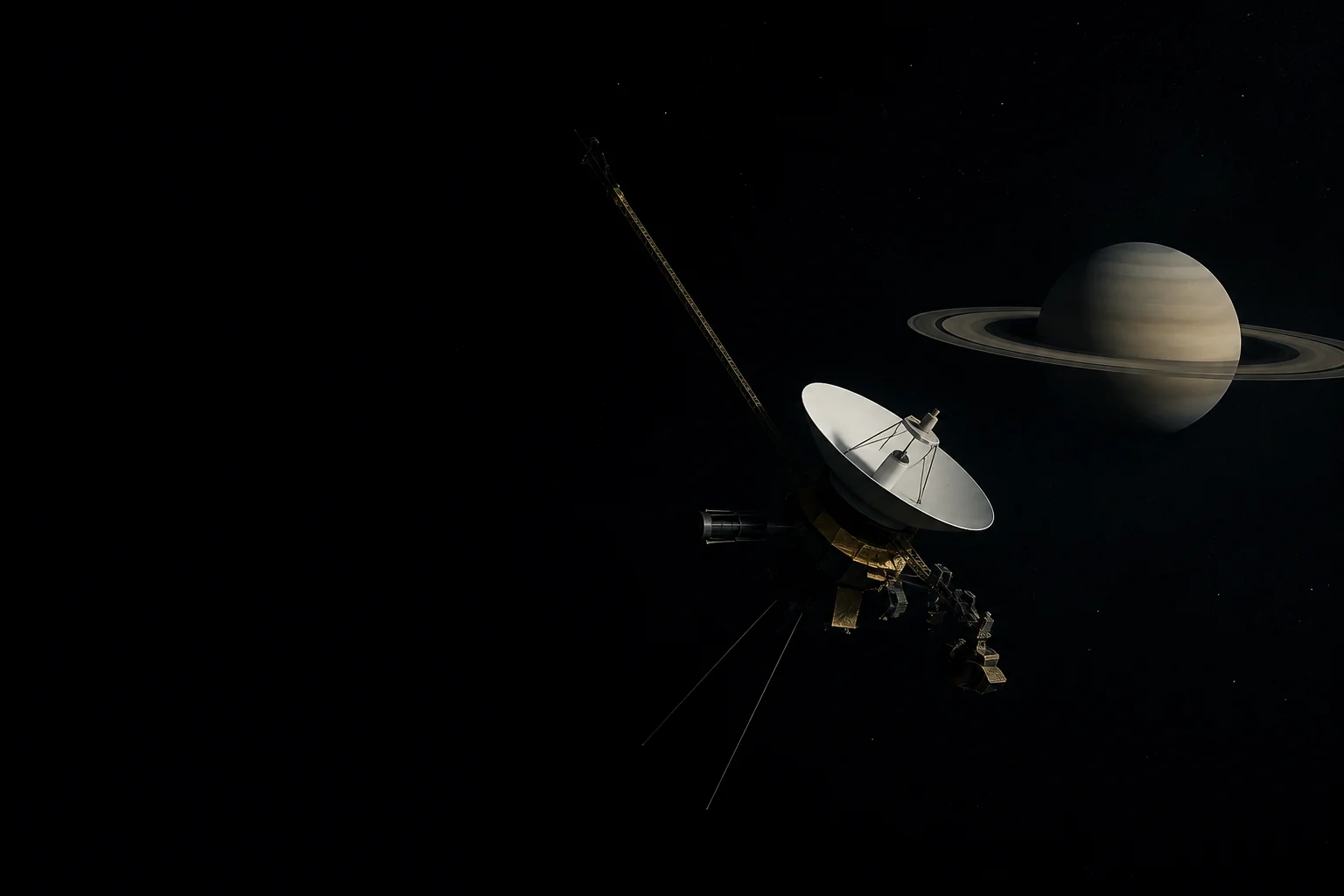
VOYAGERVoyager
The real trajectories of the two probes that left Earth in 1977 (NASA/JPL Horizons tracking data). Where they are now, where they were at any date, and a fast-forward from launch. The paths are records, not our calculation; the planet positions are this site's own.
Closest approaches to the planets (from the records)
Trajectories: NASA/JPL Horizons System (Voyager_1_ST+refit2022_m, Voyager_2_ST+refit2022_m; heliocentric vectors, 1977–2100). Tabulated every 2 days (to 1990) and 20 days (after), finer right after launch and around the flybys. Read with 8-point interpolation and rotated from the J2000 ecliptic to the ecliptic of date, the same frame as the planets. Closest-approach times and distances use the planet centres from Horizons too (Jupiter and Saturn agree with published values within 1,000 km; Uranus and Neptune differ by a few thousand km and a few minutes, because the planetary ephemerides of the era differ from today's; we show today's records as they are). Planet positions in the drawing come from Astronomy Engine (arc-minute accuracy), so flyby scenes are approximate. Voyager 1 crossed the heliopause in August 2012 and Voyager 2 in November 2018 (NASA).